
Naomi Klein has been an outspoken activist, best selling author and filmaker for many years. This interview is cross posted from “Solutions” website and delves into Ms Klein’s investigative research into the wildly swinging opinion on climate change action, and the reality of finding a solution that is equitable globally, not just for the 1%.
Throwing Out the Free Market Playbook: An Interview with Naomi Klein
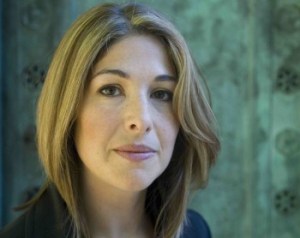 Perhaps one of the most well-known voices for the Left, Canadian Naomi Klein is an activist and author of several nonfiction works critical of consumerism and corporate activity, including the best sellers No Logo (2000) and Shock Doctrine (2007).
In your cover story for the Nation last year, you say that modern environmentalism successfully advances many of the causes dear to the political Left, including redistribution of wealth, higher and more progressive taxes, and greater government intervention and regulation. Please explain.
The piece came out of my interest and my shock at the fact that belief in climate change in the United States has plummeted. If you really drill into the polling data, what you see is that the drop in belief in climate change is really concentrated on the right of the political spectrum. It’s been an extraordinary and unusual shift in belief in a short time. In 2007, 71 percent of Americans believed in climate change and in 2009 only 51 percent believed—and now we’re at 41 percent. So I started researching the denial movement and going to conferences and reading the books, and what’s clear is that, on the right, climate change is seen as a threat to the Right’s worldview, and to the neoliberal economic worldview. It’s seen as a Marxist plot. They accuse climate scientists of being watermelons—green on the outside and red on the inside.
It seems exaggerated, but your piece was about how the Right is in fact correct.
I don’t think climate change necessitates a social revolution. This idea is coming from the right-wing think tanks and not scientific organizations. They’re ideological organizations. Their core reason for being is to defend what they call free-market ideology. They feel that any government intervention leads us to serfdom and brings about a socialist world, so that’s what they have to fight off: a socialist world. Increase the power of the private sector and decrease the public sphere is their ideology.
You can set up carbon markets, consumer markets, and just pretend, but if you want to get serious about climate change, really serious, in line with the science, and you want to meet targets like 80 percent emissions cuts by midcentury in the developed world, then you need to be intervening strongly in the economy, and you can’t do it all with carbon markets and offsetting. You have to really seriously regulate corporations and invest in the public sector. And we need to build public transport systems and light rail and affordable housing along transit lines to lower emissions. The market is not going to step up to this challenge. We must do more: rebuild levees and bridges and the public sphere, because we saw in Katrina what happens when weak infrastructure clashes with heavy weather—it’s catastrophe. These climate deniers aren’t crazy—their worldview is under threat. If you take climate change seriously, you do have to throw out the free-market playbook.
What is the political philosophy that underscores those who accept climate change versus those who deny it?
The Yale cultural cognition project has looked at cultural worldview and climate change, and what’s clear is that ideology is the main factor in whether we believe in climate change. If you have an egalitarian and communitarian worldview, and you tend toward a belief system of pooling resources and helping the less advantaged, then you believe in climate change. And the stronger your belief system tends toward a hierarchical or individual worldview, the greater the chances are that you deny climate change and the stronger your denial will be. The reason is clear: it’s because people protect their worldviews. We all do this. We develop intellectual antibodies. Climate change confirms what people on the left already believe. But the Left must take this confirmation responsibly. It means that if you are on the left of the spectrum, you need to guard against exaggeration and your own tendency to unquestioningly accept the data because it confirms your worldview.
Members of the Left have been resistant to acknowledging that this worldview is behind their support of climate action, while the Right confronts it head on. Why this hesitancy among liberals?
There are a few factors at work. Climate change is not a big issue for the Left. The big left issues in the United States are inequality, the banks, corporate malfeasance, unemployment, foreclosures. I don’t think climate change has ever been a broad-based issue for the Left. Part of this is the legacy of siloing off issues, which is part of the NGO era of activism. Climate change has been claimed by the big green groups and they’re to the left. But they’re also foundation funded. A lot of them have gone down the road of partnerships with corporations, which has made them less critical. The discourse around climate change has also become extremely technical and specialized. A lot of people don’t feel qualified and feel like they don’t have to talk about it. They’re so locked into a logic of market-based solutions—that the big green groups got behind cap and trade, carbon markets, and consumer responses instead of structural ones—so they’re not going to talk about how free trade has sent emissions soaring or about crumbling public infrastructure or the ideology that would rationalize major new investments in infrastructure. Others can fight those battles, they say. During good economic times, that may have seemed viable; but as soon as you have an economic crisis, the environment gets thrown under the bus, and there is a failure to make the connection between the economy and the climate crisis—both have roots in putting profits before people.
You write in your article, “After years of recycling, carbon offsetting, and light-bulb changing, it is obvious that individual action will never be an adequate response to the climate crisis.” How do we get the collective action necessary? Is the Occupy movement a step in the right direction?
The Occupy movement has been a game changer, and it has opened up space for us to put more radical solutions on the table. I think the political discourse in the United States is centered around what we tell ourselves the American public can handle. The experience of seeing these groups of young people put radical ideas on the table, and seeing the country get excited by it, has been a wake up call for a lot of people who feel they support those solutions—and for those who have said, “That’s all we can do.” It has challenged the sense of what is possible. I know a lot of environmentalists have been really excited by that. I’m on the board of 350.org, and they’ll be doing more and more work on the structural barriers to climate action. The issue is why? Why do we keep losing? Who is in our way? We’re talking about challenging corporate personhood and financing of elections—and this is huge for environmental groups to be moving out of their boxes. I think all of the green organizations who take corporate money are terrified about this. For them, Occupy Wall Street has been a game changer.
What comes after communism and capitalism? What’s your vision of the way forward?
It’s largely about changing the mix in a mixed economy. Maybe one day we’ll have a perfect “ism” that’s post-communism and -capitalism. But if we look at the countries that have done the most to seriously meet the climate challenge, they’re social democracies like Scandinavia and the Netherlands. They’re countries with a strong social sphere. They’re mixed economies. Markets are a big part, but not the only part, of their economies. Can we meet our climate targets in a system that requires exponential growth to continue? Furthermore, where is the imperative of growth coming from? What part of our economy is demanding growth year after year?
If you’re a locally based business, you don’t need continual growth year after year. What requires that growth is the particular brand of corporate capitalism—shareholders who aren’t involved in the business itself. That part of our economy has to shrink, and that’s terrifying people who are deeply invested in it. We have a mixed economy, but it’s one in which large corporations are controlled by outside investors, and we won’t change that mix until that influence is reduced.
Is that possible?
It is if we look at certain choke points like corporate personhood and financing, and it makes sense for us to zero in on aspects of our system that give corporations massive influence. Another is media concentration. If you had publicly financed elections, you’d have to require public networks to give airtime to candidates. So the fact that networks charge so much is why presidential elections cost more than a billion dollars, which means you have to go to the 1 percent to finance the elections. These issues are all linked with the idea that corporations have the same free-speech rights as people, so there would also be more restrictions on corporate speech.
Entrepreneur and writer Peter Barnes has argued that what’s missing is adequate incorporation of the “commons sector” in the economy—public goods like natural and social capital. “Capitalism 3.0” he calls it, which we’d achieve not by privatizing these goods but by creating new institutions such as public-asset trusts. What’s your opinion of this approach?
I definitely think it’s clear that the road we’ve been on—turning to the private sector to run our essential services—has proven disastrous. In many cases, the reason why it was so easy to make arguments in favor of privatization was because public institutions were so cut off and unresponsive and the public didn’t feel a sense of ownership. The idea that a private corporation has valued you as a customer was a persuasive argument. Now it turns out both models have failed. So this idea that there is a third way—neither private nor state-run public—is out there.
 Meanwhile, back at the Ranch. . all this in the name of austerity.


 No place like home.