“SHOW ME THE MONEY”, …..o.k.

As the world staggers at the ability of 194 nations of the world to agree that the planet is, after all, worth saving, and then agree to do something about it, the $100 BILLION per year to finance a Green Climate Fund immediately springs to mind.                 SHOW ME THE MONEY …… Here it is …….

…………………

………………..

After 2020 the world will unite to stop global temperature reaching 2 degrees above pre-industrial levels. The world will reduce its global carbon emissions by 50% (average) to prevent 2 degrees warming. Many countries will have to reduce their emissions ‘drastically’ by over 90% to meet their individual “share” of the reductions.

We are now faced with the “Green Economy” which was discussed here at ; https://awayfromitall.me/2011/09/28/the-green-economy-can-the-current-growth-system-be-the-basis/

The compliance with this “grand plan” depends on replacing the world STATIONARY energy infrastructure, ELECTRICAL  ENERGY GENERATION MUST BECOME EMISSION FREE BY 2050. Australia has a plan prepared by Beyond Zero Emissions for a 10 year transfer of Australia’s energy sector which they estimate will cost $375 BILLION over 10 years. http://beyondzeroemissions.org/

A report issued by the U.N. (W.E.S.S. 2011), “costs” this ‘global transition’ at between $15-20 TRILLION to “rewire” the world with renewable energy. So where is the money coming from?

SUSAN GEORGE, HEAD OF THE “TRANSNATIONAL INSTITUTE” (TNI) here further details the necessity for a Tobin Tax, but ALSO STRESSES THE NEED TO SHUT DOWN TAX HAVENS which deprive global governments of over $100 BILLION p.a.

…………………….

……………………

Only a few weeks ago, the I.E.A. released its World Energy Outlook stating that cost to maintain and extend the existing and proposed fossil fuel demand would, by 2035, be $38 TRILLION.

……………………….



OR


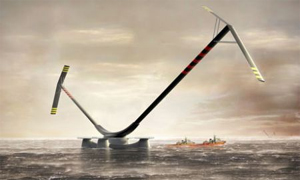
!0 Mw ocean based wind turbine. Prototype by ARUP.

…………………………………………………………………….

THIS RENEWABLE STRUCTURAL TRANSFORMATION HAS MUST BE FINISHED, FROM 2020 – 2050. AT THE SAME TIME, FOR MUCH OF THIS PERIOD, THE EXISTING ENERGY INFRASTRUCTURE WILL NEED TO RUN “ALONGSIDE” THIS TRANSFORMATION TO “BUILD IT.”

Hannah Stoddardt from OXFAM states below in a discussion with Chris Huhne, U.K. environment minister the possibility of a bunker fuel tax that would ‘compensate’ for the 6% of global emissions resulting from the SHIPPING INDUSTRY, at present NOT part of the KYOTO PROTOCOL. 10’s if not 100’s of BILLIONS of dollars are owed the planet from the 90,000 FREIGHTERS that deliver goods completely unregulated using the worst fuel possible – bunker fuel,  60,000 DEATHS REPORTED ON SHIPPING ROUTES FROM SULHUR DIOXIDE HELPED DESEASES.

Continue reading

“CLOWN of COP 17 AWARD” goes to …

PETER KENT, Canadian “ENVIRONMENT” minister.

Tar Sands “runnin’ around his brain” and anodised aluminium skeleton. A man of his word, (he has “renegged” on the Kyoto Protocol) as Canada “sold” their emissions reduction to a 40% INCREASE FROM Tar Sands. KENT KNOWS that the TAR SANDS is only 3% through the 300,000 SQUARE KILOMETERS OF BOREAL FOREST that are planned to be destroyed.                  KENT KNOWS that Canada MUST have distribution lines that destroy high value areas. KENT KNOWS that James Hansen has stated categorically that if all the tar sands are exploited it’s “GAME OVER” as far as ever reducing emissions.

THIS MAN HAD A SEEK AND DESTROY MISSION AT COP 17. He has the stated goal of abandoning Kyoto and yet had the gaul to criticise the Indian delegate, as reported in the Times of India, for holding out on the agreement ;

She rebuked the Canadian minister for pointing fingers at India, “I was astonished and disturbed by the comments of my colleague from Canada who was pointing at us as to why we are against the roadmap. I am disturbed to find that a legally binding protocol to the Convention, negotiated just 14 years ago is now being junked in a cavalier manner. Countries which had signed and ratified it are walking away without even a polite goodbye. And yet, pointing at others.”

http://articles.timesofindia.indiatimes.com/2011-12-10/global-warming/30501920_1_climate-talks-climate-change-small-island-countries

…………………………………………………………………………….

Canadian Youth Delegation turn their backs on Peter Kent as he speaks at COP 17.


………………..

……………….

DURBAN OUTCOME, U.N.F.C.C.C. link, nature.com news blog & more.

U.N.F.C.C.C. WEBSITE WITH FINAL DOCUMENTATION.

http://unfccc.int/2860.php

………………………………………….

Alden Meyer from Union of Concerned Scientists commented;

Environmentalists criticized the package — as did many developing countries in the debate — for failing to address what they called the most urgent issue, to move faster and deeper in cutting carbon emissions.

“The good news is we avoided a train wreck,” said Alden Meyer, recalling predictions a few days ago of a likely failure. “The bad news is that we did very little here to affect the emissions curve.”

…………………………………

nature.com blog ;

After a long debate, South Africa’s Maite Nkoana-Mashabane sought to broker a spontaneous compromise that has been years in the making by forcing negotiators to work out their differences on the floor of the plenary, in plain view and earshot of media and anyone else willing to push their way into a crowd (or onto a chair). All of this took place at 3 a.m. Sunday morning, making Durban the longest of 17 annual conferences convened by signatories to the UN Framework Convention on Climate Change.

Be the cause clever politicking, schoolyard peer pressure or sheer fatigue, it worked. After some 45 minutes of shifting scrums punctuated by occasional applause, India, the European Union, the United States and other key players worked out their differences on a host of interrelated issues. This time it came down to five words: “agreed outcome with legal force”. To recap, the final language states that countries will begin new negotiations on “a protocol, another legal instrument, or an agreed outcome with legal force,” which apparently falls somewhere in the legal spectrum between a binding treaty and a nonbinding decision. Both India and the EU promptly dropped their objections.

The so-called “Durban package” was adopted shortly before 5 a.m. Sunday. It extends the Kyoto Protocol and commits the world to negotiating a new agreement by 2015 that covers all countries, developed and developing. Among other things, it also advances some details of the new Green Climate Fund established last year in Cancun as well as language intended to promote efforts to reduce emissions from deforestation. Despite universal acknowledgements that the deal does nothing to reduce emissions or increase funding beyond existing commitments, environmentalists and scientists generally endorsed the decision as a significant step that could put all major emitters onto the same playing field in the years to come

http://blogs.nature.com/news/2011/12/climate_negotiators_huddle_for_1.html#more

………………………………

“Responding to Climate Change”,  reported ;

Speaking to RTCC in the Plenary Hall, the UK’s lead climate diplomat John Ashton said the talks had been a success, adding the roadmap and accompanying measures “represented closure” after Copenhagen.

Chris Huhne, UK Secretary of State for Energy and Climate Change, warned there was still work to do but was enthusiatic about the deal. “There are still many details to be hammered out, but we now need to start negotiating the new legal agreement as soon as possible and there are still many details to be hammered out,” he said.

Adrian Macey, Chair of AWG-KP, the track of the talks dealing with Kyoto said: “We’ve got a package with clarity on the Kyoto Protocol, and importantly we also have clarity on the long term too, and it’s quite momentus I think looking at this longer term agreement. Better than people expected.”

Norway’s Climate Change Minister Erik Solheim told RTCC they were “very, very pleased, it’s in the upper range of what we hoped for. We’re pleased both with the substantive outcome and also the agreement on this process.

“For us this is a great outcome. The key aspect is that it is crucial, when you have a Kyoto Protocol with limited scope…[it’s] crucial we get a legally binding framework for all major emitters and that’s the core here. It’s also important the deadline for the negotiation process is not too far into the future. So it’s the ambition level and also the urgency. We have somethig to take climate action forward and we now have an ambitious pathway to go forward,” said Solheim.

http://www.rtcc.org/policy/cop17-late-deal-saves-un-climate-talks/

………………………………….

Rueters.com have a good synopsis ;

U.N. climate change talks in Durban, South Africa, agreed a package of measures early on Sunday that would eventually force all the world’s polluters to take legally binding action to slow the pace of global warming.

After more than two weeks of intense talks, some 190 countries agreed to four main elements — a second commitment period under the Kyoto Protocol, the design of a Green Climate Fund and a mandate to get all countries in 2015 to sign a deal that would force them to cut emissions no later than 2020, as well as a workplan for next year.

http://www.stumbleupon.com/su/49vdVQ/www.reuters.com/article/2011/12/11/us-climate-deal-idUSTRE7BA07F20111211

…………………………

New U.N. climate deal struck, critics say gains modest

After a 36 hour extension to COP 17 in Durban there is a new agreement which must be finalised by 2015 to begin in 2020. The Kyoto Protocol will be extended until at least 2017.  These are the Sunday morning press that declare the agreement to the World.

N.B. – It should be noted that emissions reduction tergets have not been addressed to ensure that global warming is reduced to less than 2 degrees as agreed at Copenhagen and Cancun. HOWEVER,  a new I.P.C.C. report is due in 2014 which will update the science and the existing 2007 Data Set from I.P.C.C.

2012 NEEDS TO BE A BIG YEAR FOR THE PLANET – AS WELL AS THE COP 18 CONFERENCE AT QATAR, THERE IS THE 20th ANNIVERSARY OF “THE RIO EARTH SUMMIT”,  –  the U.N. conference which began all these discussions in 1992.

…………………………………………………………………………………..

 The 194-party conference agreed to start negotiations on a new accord that would ensure that countries will be legally bound to carry out any pledges they make. It would take effect by 2020 at the latest.

The package of accords extended the Kyoto Protocol, the only global pact that enforces carbon cuts, agreed the format of a fund to help poor countries tackle climate change and mapped out a path to a legally binding agreement on emissions reductions.

But many small island states and developing nations at risk of being swamped by rising sea levels and extreme weather said the deal marked the lowest common denominator possible and lacked the ambition needed to ensure their survival.

“We came here with plan A, and we have concluded this meeting with plan A to save one planet for the future of our children and our grandchildren to come,” said South African Foreign Minister Maite Nkoana-Mashabane, who chaired the talks.

“We have made history,” she said, bringing the hammer down on Durban conference, the longest in two decades of U.N. climate negotiations.

Britain’s Energy and Climate Secretary Chris Huhne said the result was “a great success for European diplomacy.”

“We’ve managed to bring the major emitters like the U.S., India and China into a roadmap which will secure an overarching global deal,” he said.

U.S. climate envoy Todd Stern said Washington was satisfied with the outcome: “We got the kind of symmetry that we had been focused on since the beginning of the Obama administration. This had all the elements that we were looking for.”

“It’s certainly not the deal the planet needs — such a deal would have delivered much greater ambition on both emissions reductions and finance,” said Alden Meyer of the Union of Concerned Scientists.

“Producing a new treaty by 2015 that is both ambitious and fair will take a mix tough bargaining and a more collaborative spirit than we saw in the Durban conference centre these past two weeks.”